
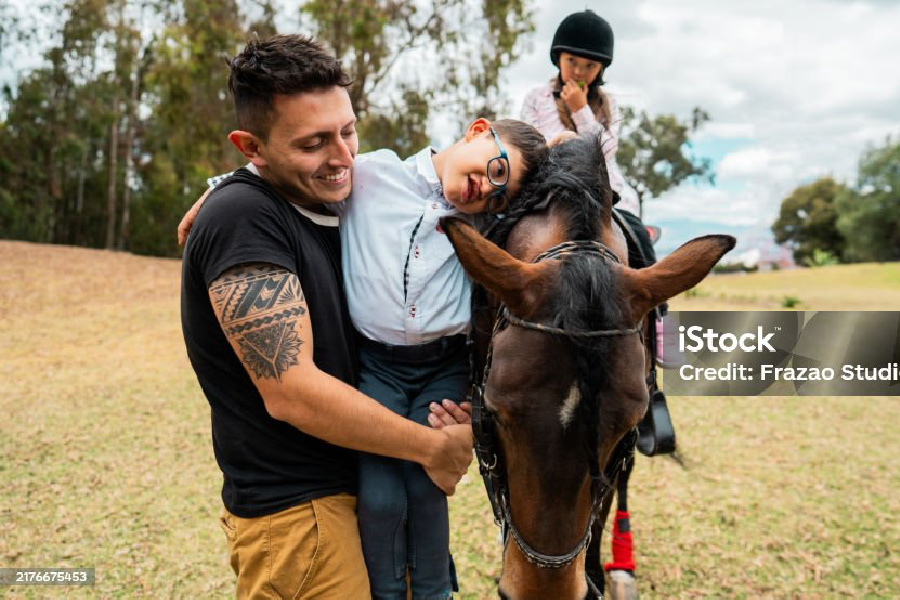
What is Equine Assisted Learning (EAL)?
When people hear about working with horses, they often think of therapy.
And yes—Equine-Assisted Therapy plays an important role.
But there’s another side to this work that focuses less on healing the past and more on building skills for the future.
It’s called equine-assisted learning.
It helps build confidence, communication, and self-awareness.
Equine-assisted learning (EAL) is a structured, experience-based approach where people work with horses to develop life skills. Not in a classroom. Not through lectures. But through real, hands-on interaction.
Participants might…
- lead a horse through an obstacle
- work as part of a team to complete a task
- learn how to communicate clearly and calmly
- notice how their own energy affects the horse’s response
And that last piece matters more than it might seem. Because the learning doesn’t come from being told what to do. It comes from seeing—immediately—what works and what doesn’t.
And here’s the important part: the horse isn’t a prop in the process—he or she is an active participant.
So why horses?
Horses respond to clarity, consistency, and presence.
They don’t respond to intention alone—they respond to what’s actually happening.
Which means if communication is unclear, they don’t follow.
If energy is scattered, they reflect it.
If someone becomes calm and focused, the horse responds in kind.
That kind of feedback is immediate, honest, and non-judgmental.
And according to research coming out of Tufts University, this type of interaction can help people build communication skills, teamwork, and stress management strategies in a way that feels natural and engaging.
https://vet.tufts.edu/news-events/news/can-equine-assisted-learning-help-students-reduce-stress
In other words, the horse becomes part of the learning process—not just the environment.
What people (young & old) actually learn
Equine-assisted learning isn’t about horse skills.
It’s about life skills.
Research has shown that participants in these types of programs can develop: stronger social skills, improved emotional awareness, better problem-solving abilities
https://www.frontiersin.org/articles/10.3389/feduc.2024.1275280/full
And for youth in particular, these environments can create a sense of emotional safety that allows learning to happen without pressure or fear of failure.
https://jyd.pitt.edu/ojs/jyd/article/view/19-14-04-RES-1
Students don’t just talk about confidence — they experience what it takes to build it.
Students don’t just learn about leadership — they see what happens when they step into it.
And that kind of learning tends to stick.
Why this matters right now
Equine-assisted learning offers something very different. It slows things down. It asks people to be present. To pay attention. To adjust in real time.
And in doing that, it builds something deeper than knowledge.
It builds awareness.
Where this fits at Healing Together With Horses
A space where people can: try something new, build confidence quietly, and learn through experience rather than instruction.
Because sometimes the most meaningful lessons don’t come from being told. They come from discovering.

We invite you to be part of what happens next
If this resonates with you -- if you believe in creating a place where horses are safe, where people can connect with horses and nature, and where something thoughtful and compassionate is possible -- we invite you to be part of continuing to build Maamawi-Noojimoiwewin Centre.

Recent blog posts
KEY BOARD WARRIORS
At Healing Together With Horses we appreciate YOUPlease don’t ever feel like you’re “only” helping by liking, commenting, or sharing. In today’s world, that kind of support is far more powerful than most people realize. Social media isn’t just a place to scroll — it’s...
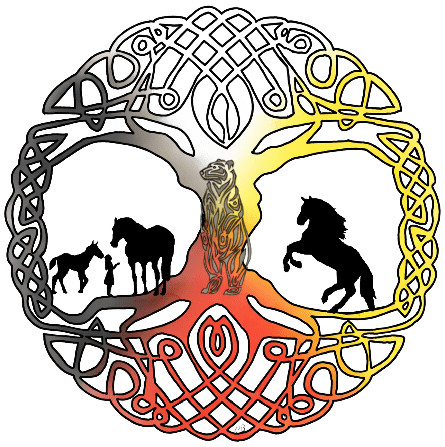
Maamawi-Noojimoiwewin is Ojibwe and means "healing together".
It speaks to the connection between people, horses, and the land -- and the journey we all share.
The name was gifted by the mother and grandmother of Kara Perrault-Barry (Garden River First Nation), who created our logo.