
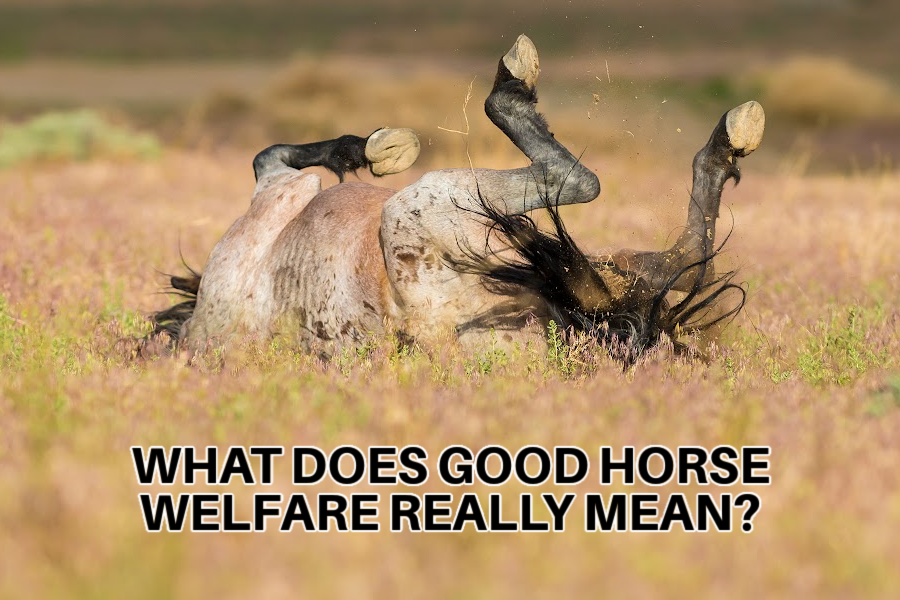
What does “good welfare” actually mean for horses?
If you’ve spent any time around animals, you’ve probably heard of the “Five Freedoms.”
The Five Freedoms have been referred to for years and they shaped how we think about animal welfare — making sure animals aren’t hungry, aren’t in pain, aren’t afraid.
And that all matters. Of course it does.
But here’s what’s becoming clearer now — that way of thinking only tells part of the story.
For a long time, the focus was mostly on preventing suffering. The idea was that if an animal isn’t in distress, then things must be okay.
But newer research is showing that it’s not quite that simple. An animal can be free from obvious suffering and still not be living a good life.
There’s a big difference between surviving… and actually living well.
Horses, like us, experience the world in more ways than just physical comfort or discomfort. Horses can feel boredom, frustration, loneliness — things that don’t always show up in obvious ways, but still matter.
Even when horses’ basic needs are being met, that doesn’t automatically mean they’re thriving.
What really makes the difference is whether they have the opportunity to experience positive things. Not just the absence of the bad, but the presence of the good.
When a horse has space to move, other horses to interact with, and an environment that allows them to explore and engage, something shifts. They’re not just existing anymore — they’re participating in their own lives. Research shows that when animals are given those kinds of opportunities, they can experience comfort, interest, confidence, even a sense of control in their surroundings.
And that matters more than we used to realize.
That’s where this idea of “a life worth living” comes in. It’s a simple concept, but a powerful one. It shifts the question from “Are they okay?” to something more meaningful: “Are they living well?”
For horses, that can mean something as basic — and as important — as having room to move, the ability to socialize, and an environment that isn’t restrictive or barren.
It’s not complicated, but it does require intention.
And honestly, it changes how you see everything.
Because once you start looking at welfare this way, it’s no longer just about care. It’s about quality of life.

We invite you to be part of what happens next
If this resonates with you -- if you believe in creating a place where horses are safe, where people can connect with horses and nature, and where something thoughtful and compassionate is possible -- we invite you to be part of continuing to build Maamawi-Noojimoiwewin Centre.

Recent blog posts

KEY BOARD WARRIORS
At Healing Together With Horses we appreciate YOUPlease don’t ever feel like you’re “only” helping by liking, commenting, or sharing. In today’s world, that kind of support is far more powerful than most people realize. Social media isn’t just a place to scroll — it’s...
Maamawi-Noojimoiwewin is Ojibwe and means "healing together".
It speaks to the connection between people, horses, and the land -- and the journey we all share.
The name was gifted by the mother and grandmother of Kara Perrault-Barry (Garden River First Nation), who created our logo.